

After a DHI hair transplant, small scabs form around the grafts and come off between about day 7 and day 14. The transplanted hairs then shed, usually in weeks 2 to 8. Fine new hair appears around month 3 to 4, the area looks clearly fuller by month 6, and most of the result is visible at 12 months.
That is the short version. Below, our team at BlueMagic Group Clinic in Istanbul walks you through the DHI hair transplant timeline from day 1 to month 12 and beyond: what you will see, what is normal, what to do at each stage and when to ask us. Every scalp heals at its own pace, so read the months as a guide, not a promise.
All about DHI hair transplant: a quick overview
DHI (Direct Hair Implantation) uses a Choi implanter pen: each graft is taken from your donor area, loaded into the pen and placed in one controlled movement, without opening channels first. The doctor sets the angle, depth and direction of every hair, which is why DHI is often chosen for hairlines and for placing grafts between existing hairs. In one of our patient videos, our team explains that DHI is the technique we use most at the clinic right now, for exactly that reason (watch on YouTube).
What DHI means for your recovery:
- No channels are opened in advance: each graft goes in as the pen makes its opening.
- Close control over the angle, depth and direction of each hair, so the new hair can follow your natural pattern.
- Grafts can be placed between existing hairs, which is why DHI is also used for DHI without shaving in suitable cases.
- The healing stages are the same as with other techniques: scabs, shedding, a quiet phase, then new growth.
The stages below follow what our patients go through after a DHI hair transplant, from the first night to the 12-month check.
DHI hair transplant timeline for recovery
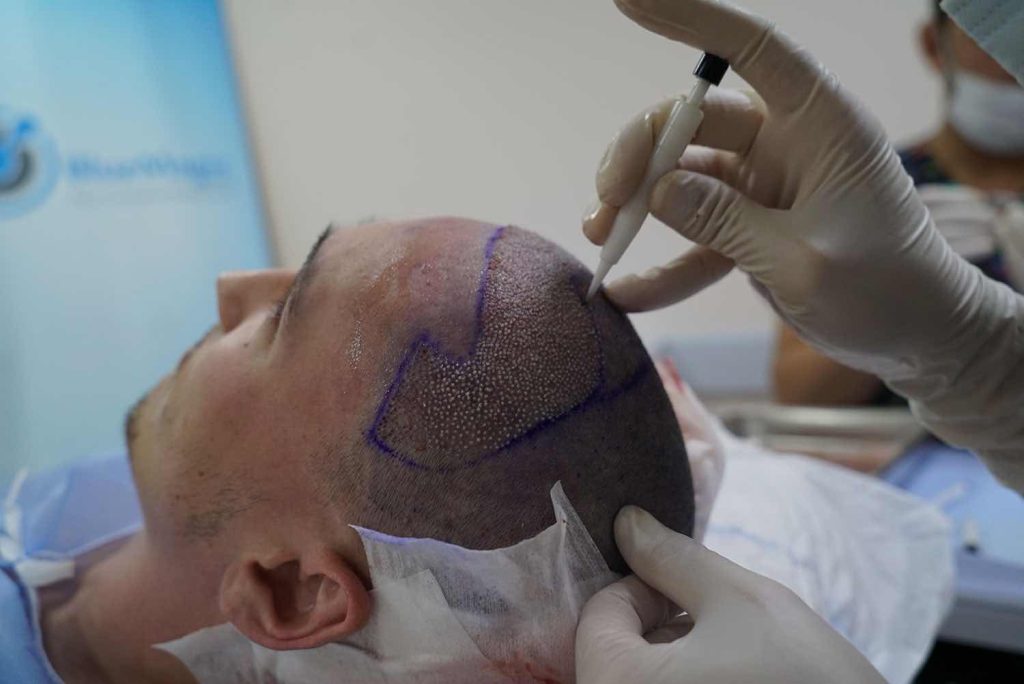
Day 1 to 3: right after the procedure
The first days matter most for the grafts. Some redness, swelling and tenderness around the donor and recipient areas is normal while your scalp starts to heal.
During this phase:
- Small scabs start to form around each implanted graft.
- You receive a written list of medicines for the next 10 days. Take them exactly as prescribed.
- Sleep with your head raised on two or three pillows for the first nights.
- Do not touch, scratch or press on the transplanted area.
- Wear shirts that open at the front, so nothing rubs the grafts.
Tip: follow your written aftercare closely in these first days. It gives the exact dates for your case, and your coordinator answers on WhatsApp if anything worries you.
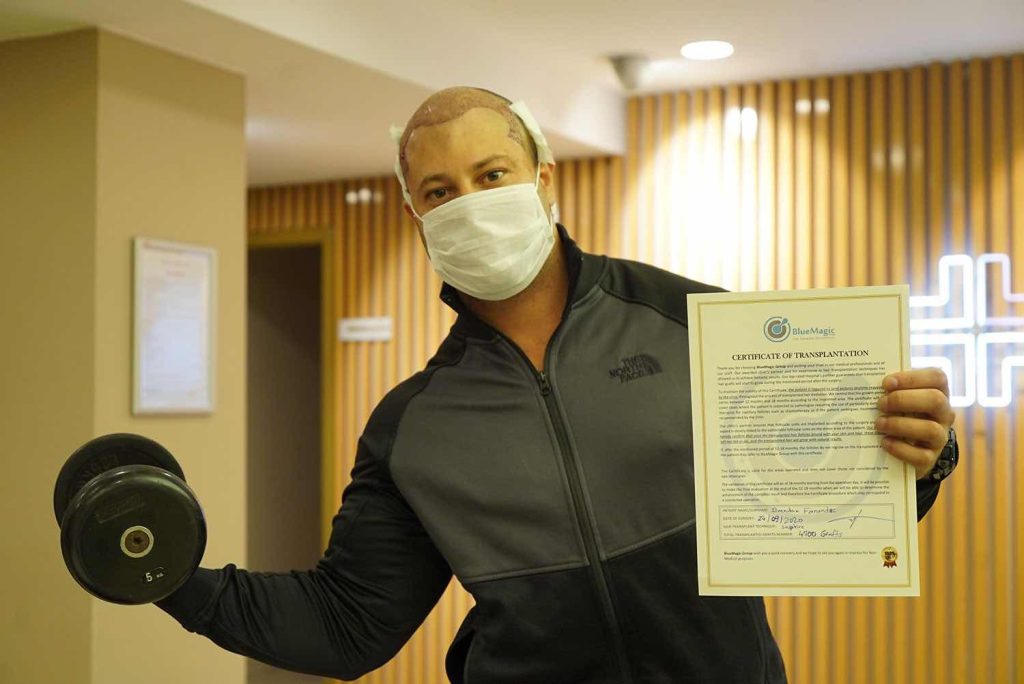
Day 4 to 10: scabs and the washing routine
The first wash is done with our team, who show you how to continue at home. From then on, washing is the most important part of your day.
One patient said in a video on the day of the first wash: “Today I had my first wash, it hurt a little bit, stung a little bit more than anything, but I mean, one step at a time.” (BlueMagic Group Clinic patient video, watch on YouTube)
Key points:
- The scabs are still there and the scalp is sensitive.
- Wash daily as shown, with the prescribed products: the lotion stays on for 10 to 15 minutes before you rinse.
- Redness slowly settles.
- Avoid heavy sweating, swimming and strenuous exercise.
- Protect your head from direct sun with a loose cap, and avoid tight hats that press on the grafts.
Day 10 to 14: the scabs lift away
Between about day 7 and day 14 the scabs come off. From day 10 the routine changes: shampoo for 20 to 30 minutes, then about 3 minutes of gentle scab massage and a lukewarm rinse, as your aftercare plan explains. Our washing guide shows each step.
What happens:
- The remaining scabs wash away.
- The scalp looks much calmer.
- Most people return to normal routines once the scabs have lifted away, usually 7 to 14 days after the procedure.
- Light walking is fine; strenuous exercise waits until the date in your written aftercare.
DHI hair restoration results: month-by-month timeline
Month 1: shedding
Month 1 is when shock loss after a hair transplant usually starts.
What you will notice:
- The transplanted hairs start to fall out, usually about 15 to 20 days after surgery.
- Most transplanted hairs fall out somewhere in weeks 2 to 8.
- The roots stay in place under the skin.
- The scalp can stay a little sensitive.
The hair shaft falls out while the root rests and prepares to grow new hair. It can look as if you are back where you started. You are not: this stage is expected, and it does not mean the grafts have failed.
Month 2 to 3: the quiet phase
Two months after a DHI hair transplant you are in the quiet phase.
During this period:
- Most of the transplanted hairs have shed.
- The roots rest under the skin.
- There is little or no visible growth yet.
- Redness keeps fading.
This is the stage that tests your patience. Around month 3, many patients see the first fine hairs. One patient wrote on Trustpilot: “I’m almost 3 months post operation and I couldn’t be happier.” Others see their first hairs later, and that is normal too.
Month 4: early growth
Between months 1 and 4 new fine hair starts to come through, and by month 4 most patients can see it.
- The new hair is thin and soft at first.
- It can grow a little curled or uneven before it settles.
- Different areas of the scalp grow at different speeds.
- The scalp can stay more sensitive for about four months.
Month 6: the area looks clearly fuller
At around 6 months, most patients see a clear change: the area looks fuller and the hairline takes shape.
- Density and coverage increase.
- The new hair gets thicker and stronger.
- It blends more naturally with the hair around it.
- No machine haircut and no hair dye for the first 6 months; shortening with scissors is fine.
Amir wrote on Trustpilot: “I have a great result after at six months of hair transplant.” Another patient, looking back in a video: “After 5 months … there was hair everywhere so that was good.” (BlueMagic Group Clinic patient video, watch on YouTube)
Month 8 to 12: maturing
Between months 8 and 12 the hair thickens, gets more texture and settles into its final look.
- The hair gains thickness and body.
- The transplanted hair blends with your own hair.
- The hairline looks settled.
Not everyone grows at the same speed. Kaveri wrote at almost 8 months: “It is almost 8 months now and I am seeing some results.” That is why we ask patients to wait for the full year before they judge.
Month 12 and after: your result
- Most of the result is visible at 12 months.
- Some patients still see change after that.
- Your final result is assessed at 12 to 18 months.
- This is the time to compare with your before photos.
The transplanted hair comes from the back and sides of your head, where hair is usually kept as other areas thin. It keeps growing like the hair it came from. Your own hair around the transplant can still thin over the years, which is why the doctor plans your hairline with the long term in mind.
DHI hair transplant before and after: what to expect
Looking at a DHI hair transplant before and after helps you see how gradual the change is. Judge photos by the months since surgery, not by the day of the procedure.
Before DHI:
- Thinning, bald areas or a receding hairline.
- Fewer styling options.
- For many people, a feeling of being self-conscious about their hair.
3 months after:
- Shedding is over and the first fine hairs may appear.
- Do not judge the result yet.
6 months after:
- The area usually looks clearly fuller.
- The hairline takes shape.
12 months after:
- Most of the result is visible.
- The hair has thickened and settled.
- Now is the time to compare with your before photos, taken in the same light and from the same angles.
You can see more patient photos on our hair transplant results page. Patience matters at every stage: the photo that counts is the one at a year, not the one in the first weeks.
DHI hair transplant success: what decides how many grafts grow
Many websites quote a graft survival percentage for DHI. We do not put a number on it here: a percentage only means something when you know how it was measured, and no clinic can promise how your own scalp will respond. What we can tell you is what makes the difference.
For a DHI hair transplant in Turkey, these are the factors that decide your result:
- Who does the work. At BlueMagic Group Clinic in Istanbul, the incisions and the extractions are done by the doctor; technicians support the doctor.
- Your donor area. The density and quality of the hair at the back and sides of your head set how many grafts can be taken safely.
- Your aftercare. How you wash, sleep and protect your scalp in the first weeks matters.
- Your hair and your health. Hair type, how advanced the loss is and how you heal all play a part.
Like any procedure under local anaesthesia, a hair transplant has risks. Possible effects include temporary swelling, numbness, itching and inflamed hair follicles, and rarely infection or lower graft survival. Read the risks in our aftercare guide before you decide.
DHI results summary chart: month-by-month timeline
What you will likely see, at a glance:
| When | What you see | What to do |
|---|---|---|
| Day 1 | The bandage comes off and the first wash is done with our team. | Watch how the team washes, so you can repeat it at home. |
| Days 1 to 14 | Small scabs around each graft and a sensitive scalp. The scabs come off between about day 7 and day 14. | Wash daily as shown. Sleep with your head raised in the first nights. Avoid heavy sweating. |
| Weeks 2 to 8 | The transplanted hairs fall out (shock loss), usually starting 15 to 20 days after surgery. | Keep following your aftercare. The roots stay in place. |
| Months 1 to 4 | New fine hair starts to come through. The scalp can stay a little sensitive. | Be patient. Send photos to your coordinator if you are unsure. |
| Month 6 | The area usually looks clearly fuller and the hairline takes shape. | No machine haircut and no dye until 6 months; scissors are fine. |
| Months 8 to 12 | The hair thickens, gets more texture and settles. | Take photos in the same light and angles as your before photos. |
| Months 12 to 18 | Most of the result is visible; your final result is assessed. | Compare with your before photos at your follow-up. |
Post-DHI care: how to protect your DHI hair transplant results
Your recovery and your result both depend on how closely you follow your aftercare. Your written aftercare gives the exact dates for your case; this is the general guidance.
Do:
- Sleep with your head raised on two or three pillows for the first nights.
- Take the prescribed medicines exactly as written, and ask the team before you take anything else.
- Wash daily with the prescribed products, as the team showed you.
- Protect your head from direct sun with a loose cap.
- Keep your follow-ups: the 12-month aftercare programme with 6 follow-ups is part of every package.
Don’t:
- Touch, scratch or press on the transplanted area.
- Do strenuous exercise or go swimming after your hair transplant while you heal: wait for the date in your written aftercare.
- Drink alcohol, smoke, or take anything that thins the blood while you heal.
- Use a machine haircut or hair dye in the first 6 months.
- Wear tight hats, helmets or anything that presses on the grafts in the first days.
Call your coordinator, and a local doctor in an emergency, if redness or swelling grows after the first days instead of settling, if pain does not ease with the prescribed medicines, or if bleeding does not stop with gentle pressure.
Who is an ideal candidate for a DHI hair transplant?
DHI gives its best results for the right person. You are likely to be a good candidate if you have:
Suits:
- Men and women whose hair loss has slowed or stabilised.
- Early to moderate hair loss, especially at the hairline and front.
- A donor area with enough density at the back and sides of the head.
- Realistic expectations about the timeline.
- Time and commitment for the aftercare.
Not a good fit:
- Very extensive hair loss with a weak donor area.
- Hair loss that is still moving fast, often in younger men: a hairline that suits you today may not suit you later.
- Health conditions that make healing or a good result unlikely: tell the doctor everything in your consultation.
- Anyone expecting instant results.
Important: we would rather decline a procedure than accept a patient whose donor area or health makes a good result unlikely. The doctor looks at your photos, your pattern of hair loss and your donor area before recommending DHI, Sapphire FUE or two sessions.
Cost of a DHI hair transplant in Turkey
Three things decide your price:
- The number of grafts you need, which depends on how advanced your hair loss is.
- Your donor area and hair type.
- The technique the doctor recommends, and whether you need one session or two.
At BlueMagic Group Clinic we price by package, not per graft. DHI packages start from €3,600. Two DHI sessions on two consecutive days start from €4,600, for up to 6,000 to 7,000 grafts in one trip. Sapphire FUE starts from €3,400. Every package includes the medical consultation, a personal translator, a 5-star hotel with breakfast (3 nights for one session, 4 nights for two), private transfers, lunch at the clinic, PRP for the grafts worth €600 and the 12-month aftercare programme with 6 follow-ups. Flights are not included.
Your exact price is in your written plan before you book. For the full breakdown, read our guides to the DHI hair transplant cost in Turkey and the hair transplant cost in Turkey.
Why get your DHI hair transplant at BlueMagic Group Clinic?
Choosing the right hair transplant clinic in Turkey matters, because you live with the result for years.
What you get with BlueMagic Group Clinic:
- 12 years in Istanbul, with two clinics in Bakırköy and Küçükçekmece.
- The incisions and the extractions are done by the doctor. Meet the medical team.
- A 12-month aftercare programme with 6 follow-ups after you fly home.
- Clear packages with the price in writing before you book.
- Patients from more than 120 countries, with reviews you can read on Trustpilot, including the critical ones.
- Consultations by video, and a head consultancy office in London for online consultations only.
Frequently asked questions
How long until I see growth after DHI?
Fine new hair usually starts to come through around month 3 to 4. The area looks clearly fuller by about month 6, and most of the result is visible at 12 months. Shedding in weeks 2 to 8 is normal and comes before the new growth.
Can I exercise during recovery?
Light walking is fine from the start. Strenuous exercise and swimming wait until the date in your written aftercare, because sweating and pressure can harm the grafts while they heal.
When can I go back to work after DHI?
Most people return to normal routines once the scabs lift away, usually 7 to 14 days after the procedure. If you want to go back without a shaved head, read about DHI without shaving.
Is shock loss permanent?
No. The transplanted hairs fall out in weeks 2 to 8, but the roots stay in place and rest before new hair grows from around month 3. If you are worried, send photos to your coordinator.
When can I dye or cut my hair?
No hair dye and no machine haircut for the first 6 months. Shortening your hair with scissors is fine.
How long do DHI results last?
The transplanted hair comes from the back and sides of the head and keeps growing like the hair it came from. Your own hair around it can still thin with time, so the doctor plans your hairline for the long term.
Start your DHI hair transplant at BlueMagic Group Clinic
DHI takes patience: about a year from the day of the procedure to the result you judge.
At BlueMagic Group Clinic we stay with you from the first consultation to your follow-ups in the 12 months after you fly home.
Your next steps:
- Send us your photos and book a free video consultation.
- Within 24 hours, receive a written plan with the technique, your graft estimate and the number of sessions.
- See your price in writing, with what is included.
- Decide in your own time. There is no obligation.
Get your free plan and find out what DHI can do for your hairline.
Medical disclaimer: results vary with age, hair type, how advanced the hair loss is and how closely you follow your aftercare. A doctor decides in consultation whether DHI is right for you.
This article is general information and does not replace a medical consultation. Your plan is based on your own photos and health history.


