

DHI and FUE take the grafts from the donor area in the same way. The difference is how the grafts go in. With FUE, the surgeon first opens small channels in the thinning area and then places the grafts into them; at BlueMagic Group Clinic we open those channels with sapphire blades (Sapphire FUE). With DHI, each graft is loaded into a Choi implanter pen and placed directly, with no separate channel step. DHI gives fine control at the hairline and between existing hair; Sapphire FUE suits larger areas in one session. Neither is better for everyone: our medical team chooses with you, from photos of your hair.
Last updated: November 2026.
DHI vs FUE at a glance
| Sapphire FUE | DHI (Choi pen) | |
|---|---|---|
| How grafts are taken | One by one from the donor area | The same: one by one from the donor area |
| How grafts go in | Channels are opened first, then the grafts are placed into them | The Choi pen places each graft directly, with no separate channel step |
| Often chosen for | Larger areas, dense and even coverage in one session | Hairlines, precision zones, thinning areas between existing hair |
| Shaving | Usually shaved | Usually shaved; partial-shaven DHI is possible in suitable cases |
| Time at the clinic | About 6 to 8 hours, in one day | About 6 to 8 hours, in one day; 2× DHI is two sessions on two consecutive days |
| Package at BlueMagic Group Clinic | From €3,400 | From €3,600 (2× DHI from €4,600) |
The choice depends on your donor area, how large the thinning area is, your hair type and whether you want to avoid a full shave. Both techniques move your own hair, and both need a careful team. Our full prices and what each package includes are on the prices page.
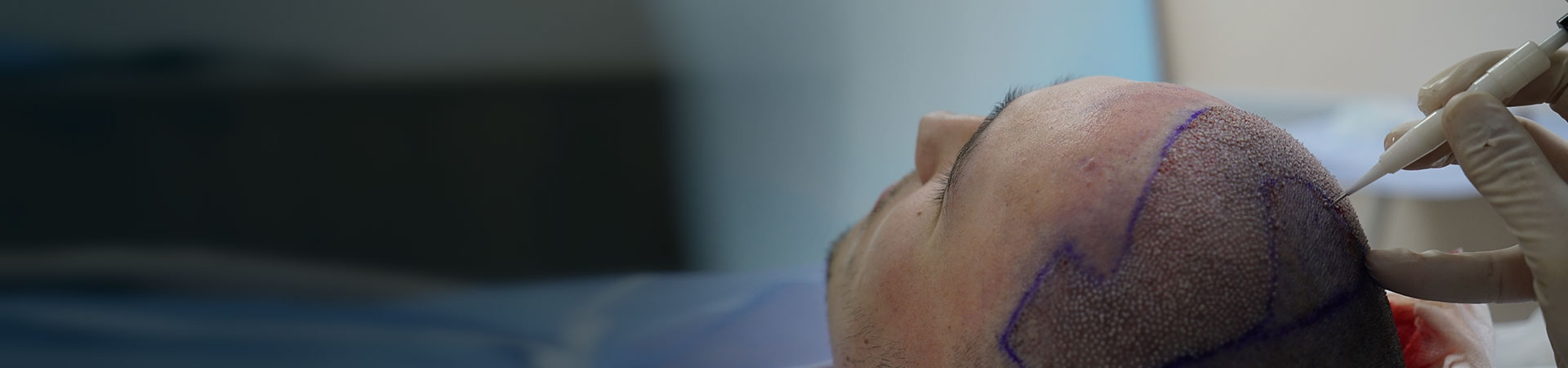
Understanding DHI and FUE: the fundamental difference
Both are modern ways of moving follicular units, the small natural groups of hair, from the back and sides of the head to where hair is thin. The extraction is the same. What changes is the implantation: two steps with FUE, one step with DHI. That one difference explains most of what you read about cost, time and who each technique suits. If you want to know how prices work in general, see our guide to hair transplant cost per graft.
What is FUE (Follicular Unit Extraction)?
FUE is the most widely used hair transplant technique. A Sapphire FUE procedure has three stages:
- Extraction: grafts are taken one by one from the donor area at the back and sides of the head.
- Channel opening: the surgeon opens small channels in the thinning area. At BlueMagic Group Clinic this is done with sapphire blades, and the channels set the angle and direction of the new hair.
- Placement: the grafts are placed into the channels one by one.
FUE can move a large number of grafts in one session, so it suits wide areas, such as the top and the crown together, as in a 3,000 grafts or 4,000 grafts plan. For a full guide, read FUE hair transplant in Turkey.
What is DHI (Direct Hair Implantation)?
DHI uses the same extraction as FUE. The difference comes at implantation: each graft is loaded into a Choi implanter pen, and the pen places it into the scalp in one movement. Our clinic video explains it simply:
With DHI, each graft is placed directly into the scalp using an implant pen. This allows the surgeon to control angle, direction, depth at the exact moment of implantation. There is no separate step for opening channels.
From our clinic video “What is DHI?”
Because the pen places grafts between hairs that are still there, DHI is often used when a patient is thinning rather than bald, and for partial-shaven DHI. More about the tool itself is in our guide to the Choi implanter pen.
DHI method vs FUE: detailed technique comparison
The two-step FUE process
With FUE, the channel opening and the graft placement are two separate steps. The surgeon first opens all the channels in the planned area, choosing the angle and direction of each one so the new hair grows the way natural hair does. The team then places the grafts into those channels.
The quality of the channel work decides much of the result: the angles, the spacing and how the hairline is drawn. This is why the plan matters more than the name of the technique.
The one-step DHI process
With DHI, opening and placing happen together. The Choi pen makes the opening and leaves the graft in it in a single movement, so the surgeon sets the angle, direction and depth graft by graft.
This takes time and a very experienced team. It also means DHI is not always the right choice for very large areas in one session. For a large plan, our signature 2× DHI splits the work into two sessions on two consecutive days, for up to 6,000 to 7,000 grafts in one trip.
Choi pen vs sapphire: tool technology comparison
| Sapphire blade (Sapphire FUE) | Choi implanter pen (DHI) | |
|---|---|---|
| What the tool does | Opens the channels before placement | Opens and places in one movement |
| Who sets the angle | The surgeon, when opening each channel | The surgeon, at the moment each graft goes in |
| Strong point | Even coverage across a large area | Precision at the hairline and between existing hair |
| Limit | A separate placement step after the channels | Slower; not always ideal for a very large area in one session |
Our doctors use both tools, and many plans use the strengths of each. The comparison of sapphire with older steel blades is in Sapphire FUE versus classic FUE.

DHI vs FUE cost: what you pay at BlueMagic Group Clinic
At BlueMagic Group Clinic in Istanbul, a Sapphire FUE package starts from €3,400 and a DHI package from €3,600. 2× DHI, two sessions on two consecutive days, starts from €4,600. We price by package, not per graft; your graft number is part of your written plan. A full breakdown of DHI prices is in our guide to DHI hair transplant cost in Turkey.
FUE cost comparison
| Package | From | Sessions | Hotel nights |
|---|---|---|---|
| Sapphire FUE | €3,400 | One session | 3 nights |
| DHI | €3,600 | One session | 3 nights |
| 2× DHI | €4,600 | Two sessions on two consecutive days | 4 nights |
DHI costs a little more because each graft is placed with the pen, which takes more time and an experienced team. The price that matters is the one in your written plan, after the medical team has seen your photos.
Location impact
Many patients choose Istanbul because one package covers most of the trip. Every BlueMagic Group Clinic package includes:
- a 5-star hotel with breakfast;
- PRP included free with every hair transplant package, worth €600;
- a 12-month aftercare programme with 6 follow-ups after you fly home.
Flights are not included. When you compare clinics, compare the written plan, who does each step and the aftercare, not only the price. Our guide to the best hair transplant clinic in Turkey lists the questions to ask, and the hair transplant cost in Turkey page covers prices by graft number.
FUE vs DHI density: achieving natural fullness
Density depends first on your donor area. Every plan is a choice between a dense result on a smaller area and a lighter result over a larger one. The technique changes how the grafts are placed, not how many good grafts your donor area can give.
DHI’s density advantage
DHI helps most where precision counts:
- the front hairline, where every angle shows;
- the temples and other precision zones;
- thinning areas where grafts go between existing hairs.
In our consultation videos, the team draws the hairline as a soft zigzag, not a flat line, so it looks natural when the hair grows.
FUE density considerations
Sapphire FUE suits large areas that need dense, even coverage in one session. Our video on the two techniques gives 3,000 to 5,000 grafts per session as typical for FUE. With a good donor area, our doctor explains, Sapphire can reach five or six thousand grafts in one session.
It usually takes more time. It requires a very experienced team, and it’s not ideal for very large sessions where speed and volume are required. Using DHI everywhere is not always the smartest choice.
From our clinic video “What is DHI?”

Recovery time: DHI vs FUE healing process
Recovery after DHI and after FUE is much the same, because the extraction is the same and both leave small marks in the recipient area that heal in the first weeks. Your aftercare plan tells you what to do each day.
DHI recovery timeline
After DHI, the recipient area shows small crusts around the grafts. You stay in Istanbul for 3 hotel nights for one session, or 4 nights for 2× DHI. Your first hair wash is usually the day after surgery, with a check of the grafts.
FUE recovery timeline
After Sapphire FUE, the steps are the same. The table below shows what usually happens after either technique:
| When | What usually happens |
|---|---|
| The next day | First hair wash and a check of the grafts |
| The first days | Swelling and some discomfort are common; the scalp needs gentle care |
| Day 7 to day 14 | The crusts fall off; up to 2 weeks is normal |
| The first weeks to months | Transplanted hair usually sheds; this is expected and the follicles stay |
DHI vs FUE results: long-term outcome comparison
Graft survival rates
Many websites give a fixed survival percentage for each technique. No clinic can promise one for your case, and a hair transplant has no guaranteed result. What a clinic can do is plan carefully, handle the grafts with care and follow your growth with you during the 12-month aftercare programme.
Timeline to full results
DHI and FUE grow on the same timeline. Everyone grows at their own speed, so these are ranges, not promises. Our DHI results timeline explains each stage.
| When | What usually happens |
|---|---|
| The first months | Transplanted hair sheds, then the follicles rest |
| The following months | Fine new hair starts to grow, then gets thicker |
| Around 12 months | Most of the result is visible; hair can keep maturing after that |
Aesthetic quality comparison
With either technique, a natural look comes from the plan: the hairline drawn above the forehead muscles and suited to your face, finer grafts at the front, and an even spacing. Done well, neither technique is visible to someone who does not know.
FUE hair transplant vs DHI: which should you choose?
Ideal candidates for DHI hair transplant
DHI often suits you if you:
- want work on the hairline or the temples;
- are thinning, with hair still in the area, rather than fully bald;
- want to avoid a full shave (partial-shaven DHI, in suitable cases);
- need a large number of grafts over two days with 2× DHI.
Ideal candidates for FUE hair transplant
Sapphire FUE often suits you if you:
- have a larger bald area, such as the top and the crown together;
- want dense, even coverage in one session;
- want the package that starts from the lowest price;
- have afro hair: see our guide to afro hair transplant techniques.
Many patients do not choose the technique themselves. One patient told us:
I did not choose the method. Pasquale told me that DHI was a better option for me. So I trust his judgment.
A patient from the USA in our video “Coach from USA got a crazy Hair Transplant in Turkey”, about Pasquale Minasi, CEO and co-founder of BlueMagic Group Clinic
Medical considerations
Neither technique is right for everyone. A hair transplant may not be suitable, or may need to wait, if:
- your donor area is too thin to give enough good grafts;
- your hair loss is still changing fast and the pattern is not yet clear;
- you have a medical condition or take medicines the medical team needs to check first;
- your scalp has an active problem that needs treatment first;
- you expect a result your donor area cannot give.
The BlueMagic Group Clinic approach to DHI vs FUE hair transplant
BlueMagic Group Clinic has carried out more than 35,000 procedures for patients from more than 120 countries, and has worked in Istanbul for 12 years. We do not push one technique. Before you travel:
- our medical team looks at photos of your donor area and the thinning area;
- you get a written plan with the graft number and the technique that suits your case;
- you see your exact price and what the package includes;
- the hairline is designed with you, to suit your face.

Honest risks of DHI and FUE
Both are surgery, and both carry the same kinds of risk:
- swelling, redness and some discomfort in the first days;
- shedding of the transplanted hair in the first weeks, which is expected;
- a result that grows more slowly or less densely than hoped;
- the hair around the transplant can keep thinning with age, so a later procedure may be needed;
- a donor area that is over-harvested can look thin, which is why we protect it.
Following the aftercare plan and attending the follow-ups gives you the best chance of a good result.
Frequently asked questions
What is the main difference between DHI vs FUE hair transplants?
The implantation. FUE opens channels first and places the grafts in a second step. DHI places each graft directly with a Choi pen, in one step.
Which is more affordable: DHI or FUE?
At BlueMagic Group Clinic, Sapphire FUE starts from €3,400 and DHI from €3,600. Flights are not included.
Which method offers better density: DHI or FUE?
DHI gives more control at the hairline and between existing hair. Sapphire FUE suits dense, even coverage of a larger area. Your donor area sets the limit for both.
How long does recovery take after FUE and DHI?
About the same. Your first wash is usually the next day, and the crusts usually fall off within 2 weeks.

FUE hair transplant vs DHI: which is better?
Neither for everyone. Our medical team recommends one from your photos.
Can I get DHI without shaving my head?
In suitable cases, yes, with partial-shaven DHI. See DHI without shaving.
Is DHI hair transplant permanent?
Transplanted hair comes from the donor area, which is usually stable, so it normally keeps growing. More in is DHI permanent?.
What is the difference between Choi pen vs Sapphire FUE?
A sapphire blade opens the channels before placement. A Choi pen opens and places in one movement.
Contact BlueMagic Group Clinic today
Send us photos of your hair loss and your donor area. Our medical team looks at them, and within about 24 hours you get in writing, with no obligation:
- how many grafts you need;
- whether DHI, Sapphire FUE or 2× DHI suits your case;
- your exact price, and what it includes.
BlueMagic Group Clinic has a Trustpilot score of 4.6 from 1,475 reviews (checked 29 October 2026).
Get my free plan or contact us.
Medical note: this article is general information and not medical advice. Results differ from person to person. Your own plan comes from a medical assessment of your case.
This article is general information and does not replace a medical consultation. Your plan is based on your own photos and health history.


