

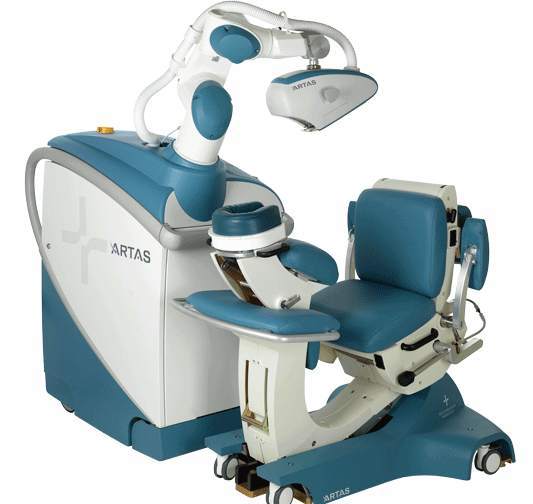
A robotic hair transplant is an FUE hair transplant in which a computer-guided arm, best known as the ARTAS system, finds and removes the grafts from the donor area. The robot handles the harvesting step. Planning the hairline and implanting each graft are still done by a medical team, so a “robotic DHI” is really robotic extraction followed by manual implantation with a pen. At BlueMagic Group Clinic in Istanbul, both steps are done by hand, with Sapphire FUE (Follicular Unit Extraction) from €3,400 and DHI (Direct Hair Implantation) from €3,600.
This page explains what the robot does, what the research says about its results, how it compares with manual FUE and DHI, and what to ask before you choose. We first published it in 2024 and have now corrected it: the old version said robots damage more grafts, and the most recent comparison study we found does not show that.
Last updated: November 2026.
Robotic hair transplant: the short version
| Question | Short answer |
|---|---|
| What does the robot do? | It analyses images of the donor area and takes out follicular units with a needle and punch |
| Does it place the grafts? | No. Implanting the grafts is done by the medical team |
| Is it approved in the US? | ARTAS is FDA cleared (510(k) K103428, April 2011), which is a clearance, not a drug-style approval |
| Does it damage more grafts? | A 2024 study found no significant difference in transection, but more grafts discarded on the robot side |
| Does BlueMagic Group Clinic use it? | No. Sapphire FUE and DHI are done by hand by the medical team |
What is a robotic hair transplant?
The ARTAS system was developed by Restoration Robotics, Inc. The US Food and Drug Administration cleared it for harvesting follicular units in April 2011 (510(k) number K103428 in the FDA device database). Our first version called it “FDA-approved”. The correct word for this kind of device is “cleared”.
A review of the system by Rose and Nusbaum describes how it works: the robot analyses images of the donor area, then uses a dual-chamber needle and a blunt dissecting punch to harvest the follicular units (Artas system, Dermatologic Clinics, 2014). In other words, it automates the extraction step of FUE.
A 2025 review of FUE devices notes that robotic technology is now also used to make the small incisions where grafts go (Chauhan and colleagues, Journal of Cutaneous and Aesthetic Surgery). None of the sources we read describes a robot that implants the grafts. That step, and the design of the hairline, stay with people.
What are the limits of a robotic hair transplant?
The first version of this page listed five “flaws”. Some held up when we checked them and one did not. Here is each point again, with what the evidence actually says.
Does a robot damage more grafts? (the transection question)
Transection means cutting through a follicle while removing it, so the graft may not grow. The best direct comparison we found is Zhu and colleagues, Journal of Cosmetic Dermatology, 2024. Thirteen men had ARTAS on one side of the donor area and manual FUE on the other side, so each man was his own control.
| Measure | ARTAS side | Manual FUE side | Statistically significant? |
|---|---|---|---|
| Yield (usable grafts) | 82.05% | 90.03% | No |
| Discard rate | 10.71% | 5.46% | Yes |
| Transection rate | 13.17% | 13.96% | No |
So the claim on our old page, that robots have a higher transection rate, is not supported by this study. What it did find is that more grafts were thrown away on the robot side. Patient satisfaction did not differ, and no complications were reported. It is one small study of 13 men in China, so it cannot settle the question either way.
Can a robot adapt to each patient?
Hair and skin differ from person to person: curl, thickness, angle of growth and how firmly the follicle sits. The 2025 device review says surgeons need to understand how their tools can be adjusted to the hair and skin of each patient (Chauhan and colleagues). A robot follows its image analysis. A surgeon working by hand can change the punch, the angle and the depth graft by graft.
That flexibility matters most where hair is curly or Afro textured, or where the donor area is limited and every graft counts.
Does the robot replace the medical team’s experience?
No. Even with a robot, people decide how many grafts you need, where the hairline sits and how the grafts are spread between the front, the middle and the crown. Those choices shape the result more than the extraction tool does.
DHI is not better or worse. It’s more precise, and precision only works in the right hands for the right case.
BlueMagic Group Clinic, in the video What is DHI?
What about touch and judgment during the operation?
In DHI each graft is loaded into a Choi implanter pen and placed straight into the scalp. The person holding the pen decides the angle, direction and depth at that moment, which is the part of the work most people mean when they talk about a natural hairline.

With DHI, each graft is placed directly into the scalp using an implant pen. This allows the surgeon to control angle, direction, depth at the exact moment of implantation.
BlueMagic Group Clinic, in the video What is DHI?
Who looks after you before and after the procedure?
Care is the clinic’s job whichever tool is used. A robot does not explain the plan, check on you or follow your growth. At BlueMagic Group Clinic every package includes:
- A medical consultation, with your hairline and graft plan agreed with you
- A personal translator, from arrival to departure
- 5-star accommodation with breakfast: 3 nights for one session, 4 nights for two
- Private transfers between the airport, hotel and clinic
- PRP treatment for the grafts, included free and worth €600
- A 12-month aftercare programme with 6 follow-ups after you fly home
How does a robotic transplant compare with manual FUE and DHI?
The three methods share the same idea: move your own follicles from the back and sides of the head to the thinning area. They differ in who or what does each step.
| Step | Robotic FUE (ARTAS) | Manual Sapphire FUE | Manual DHI |
|---|---|---|---|
| Graft extraction | Robot arm with needle and punch | Medical team, by hand | Medical team, by hand |
| Opening the recipient sites | Medical team, or a robot in newer setups | Fine sapphire channels, opened by hand | No separate step: the pen makes the site as it implants |
| Implanting the grafts | Medical team | Medical team, by hand | Medical team, with a Choi pen |
| Hairline design | Medical team | Medical team | Medical team |
| Price at BlueMagic Group Clinic | Not offered | From €3,400 | From €3,600 |

Our old page said manual FUE and DHI “generally yield higher success rates” than robotic transplants. We could not find a study that shows this, so we have removed it. The fair summary is that a skilled team using any of these methods can get a good result, and that the team matters more than the machine. If you are comparing the two manual methods, see our guide to DHI vs FUE.
How does BlueMagic Group Clinic approach hair restoration?
At BlueMagic Group Clinic, the medical team does every step by hand, from the plan to the last graft. You choose between three packages, and your consultation decides which one suits your hair:
| Package | From | Sessions | Nights in Istanbul |
|---|---|---|---|
| Sapphire FUE | €3,400 | One session | 3 nights |
| DHI | €3,600 | One session | 3 nights |
| 2× DHI | €4,600 | Two sessions on two consecutive days, up to 6,000 to 7,000 grafts | 4 nights |
A procedure usually takes 6 to 8 hours. DHI is not the right choice for every case, and our own team says so openly:
It usually takes more time. It requires a very experienced team, and it’s not ideal for very large sessions where speed and volume are required.
BlueMagic Group Clinic, in the video What is DHI?
That is why very large cases are often split over two days, or done with Sapphire FUE. See hair transplant cost in Turkey for what decides your price.
What are the honest risks, whichever method you choose?
A robot does not remove the normal risks of a hair transplant, and neither does working by hand. Before you book, know that:
- Some grafts may not grow, and results differ from person to person
- Shock loss, a temporary shedding of existing hair, can happen in the weeks after surgery
- Redness, swelling, scabs and numbness are common for a while
- Infection is uncommon but possible, which is why the aftercare rules matter
- Taking too many grafts can thin the donor area for good, so the graft number must fit your donor area
- Your own hair loss can continue, so some people later need a second session or medication
No clinic can promise a result. A good clinic tells you what is realistic for your hair before you travel.
Robotic hair transplant: frequently asked questions
Is a robotic hair transplant better than DHI?
Not as a rule. The robot only automates extraction, while DHI is about how the grafts are implanted. The one split-scalp study we found showed similar transection and satisfaction, with more grafts discarded on the robot side.
Is the ARTAS robot FDA approved?
It is FDA cleared through the 510(k) route, first in April 2011, for harvesting follicular units. That is the usual route for this kind of medical device.
Can a robot do the whole hair transplant?
No. In the sources we read, the robot harvests grafts and can make incisions. Planning, hairline design and implantation are done by the medical team.

Does BlueMagic Group Clinic offer robotic hair transplants?
No. Our packages are Sapphire FUE, DHI and 2× DHI, done by hand. See the manual hair transplant page for how that works.
Which method is right for me?
That depends on your donor area, the size of the area to cover and your hair type. Send photos of the front, top, crown, back and sides through our free hair plan page, and the medical team replies with a written plan, graft number and price.
The final word: robot or hands?
A robot can take grafts out of the donor area with consistent movements, and the research so far shows it can do that safely. It does not design your hairline or place your grafts, and the evidence does not show that it gives better results than a skilled team working by hand with FUE or a DHI hair transplant.
Choosing a method and a clinic affects how you look and feel for years. Ask any clinic who does each step, how many grafts they plan and why, and what happens if growth is slower than expected.
BlueMagic Group Clinic has worked in Istanbul for 12 years, with more than 35,000 procedures for patients from 120+ countries, and is rated 4.6 on Trustpilot from 1,475 reviews (checked 29 October 2026). The clinic is led by its CEO and co-founder, Pasquale Minasi. If you are thinking about FUE or DHI, book a FREE hair transplant consultation and get advice for your own hair.
- Get a free hair plan from your photos
- See real results in our hair transplant before and after gallery
- Compare our packages and prices
- Read how to choose the best hair transplant clinic in Turkey
This article is general information and does not replace a medical consultation. Your plan is based on your own photos and health history.


